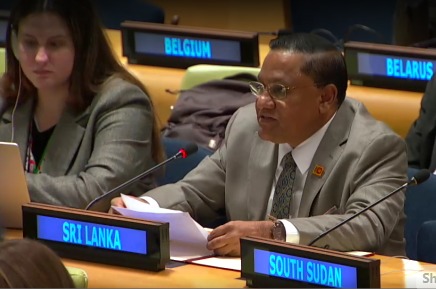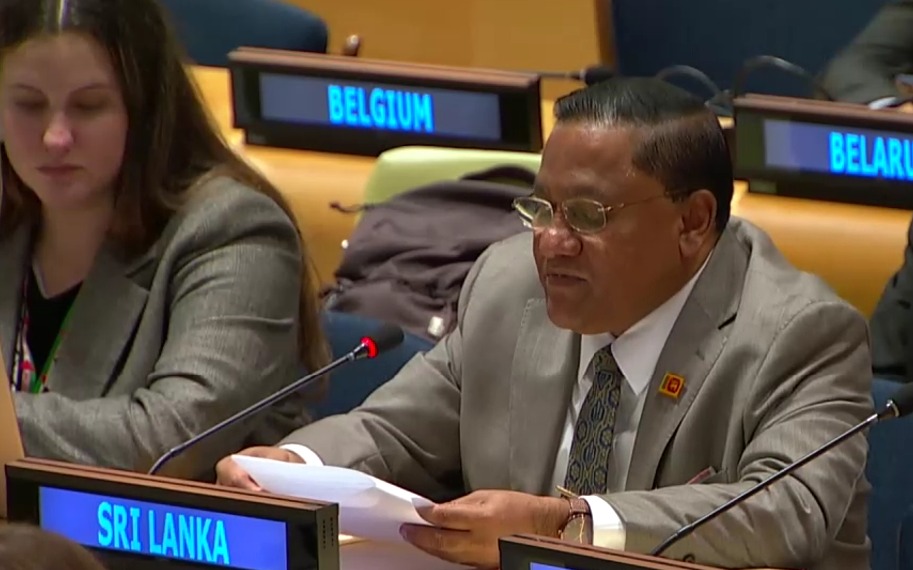


Statement by Hon. Vijitha Herath, Minister of Foreign Affairs, Foreign Employment and Tourism
Democratic Socialist Republic of Sri Lanka
High-level Plenary Meeting to Commemorate the International Day for the Total Elimination of Nuclear Weapons
29 September 2026
Mr. President, Excellencies, Distinguished Delegates,
Sri Lanka welcomes the convening of this High-Level Plenary Meeting to commemorate and promote the International Day for the Total Elimination of Nuclear Weapons.
My delegation wishes to add its voice in support of the statement delivered on behalf of the Non-Aligned Movement. While reflecting the same stance in our national policy-making and endeavours, we have certain specific principles that guide our approach on nuclear disarmament and non-proliferation.
Mr. President,
Nuclear weapons remain an existential threat to humanity and to international peace and security.
Sri Lanka is an island, maritime and sea-faring nation that lies at the crossroads of the Indian Ocean. For us, international and regional security is not a matter of choice, and nor is conflict. Peace and stability are an essential imperative for our collective survival and advancement. In these times of volatility, we are all too anxious about possible consequences that may make our determined, long-term efforts towards nuclear non-proliferation futile.
It is our considered view that nuclear escalation, whenever and wherever it may occur, can only entail far reaching consequences for global peace and security – a perverse outcome which humanity is all the more fervent to avoid in the first place. Maritime security, international and regional trade, essential goods and energy supplies, and much more, would be in greater peril as would the livelihoods of peoples and the environment both in the immediate theatre of conflict and far beyond.
As a developing nation, much concerned about its security, and much more desirous of an inclusive future which leaves no country and no people behind, the focus of our policy and vision has always remained nuclear disarmament.
Nuclear disarmament has long stood at the foundation of Sri Lanka’s foreign policy. As a founding member of the Non-Aligned Movement, we have championed peaceful coexistence since our independence. In 1971, it was Sri Lanka that brought to the United Nations the call for the Indian Ocean to be recognized as a Zone of Peace.
Mr. President,
In 1978, Sri Lanka also championed the UN General Assembly First Special Session Devoted to Disarmament (SSOD 1), which is a noble milestone that reaffirmed “effective measures of nuclear disarmament and the prevention of nuclear war have the highest priority” by its Final Report.
I also have the honour to recall that it was under Sri Lanka’s Presidency that the indefinite extension of the Nuclear Non-Proliferation Treaty (NPT) was achieved at the 1995 NPT Review Conference with landmark decisions on global nuclear disarmament, including the Resolution on the Middle East.
Lasting peace is built gradually, through dialogue and sustained efforts to build trust. Sri Lanka is concerned not only about the expansion and modernization of nuclear arsenals, but also about the increasing reliance on nuclear deterrence by States.
These weapons stand against values that run deep in our society; the teachings of non-violence and the interconnectedness of all life. Their harm does not end with the initial devastation but can continue for generations, through radiation and lasting damage to the environment.
Mr. President,
The failure to reach a consensus outcome at the Review Conference of the Non-Proliferation Treaty is deeply concerning. Sri Lanka reaffirms its commitment to the Non-Proliferation Treaty and to the Treaty on the Prohibition of Nuclear Weapons, which we joined in 2023. In the same year, we ratified the Comprehensive Nuclear-Test-Ban Treaty. We call on the nuclear-armed States to halt the modernization and expansion of their arsenals and to take concrete, time-bound steps toward disarmament. The vast resources now devoted to these weapons could instead support sustainable development, through energy, health and education, and action on the climate crisis, particularly in the developing countries.
Mr. President
In conclusion, let me also recall the opinion of Justice C.J. Weeramantry, a renowned Sri Lankan judge and a former Vice President of the International Court of Justice (ICJ) on the Legality of the Threat or Use of Nuclear Weapons in 1996.
Quote
“Use or threat of use of nuclear weapons is illegal in any circumstances whatsoever. It violates the fundamental principles of international law, and represents the very negation of the humanitarian concerns which underlie the structure of humanitarian law.”
Unquote
Nuclear weapons have threatened humanity for too long. Sri Lanka will continue to work with determination for their total elimination.
I thank you, Mr. President.